A First-Time Visitor’s Festival Day: Plan Three Anchors, Leave the Gaps Open
Plan a first-time festival day with three clear anchors, practical access checks and open gaps for rest, discovery or a change of plan.
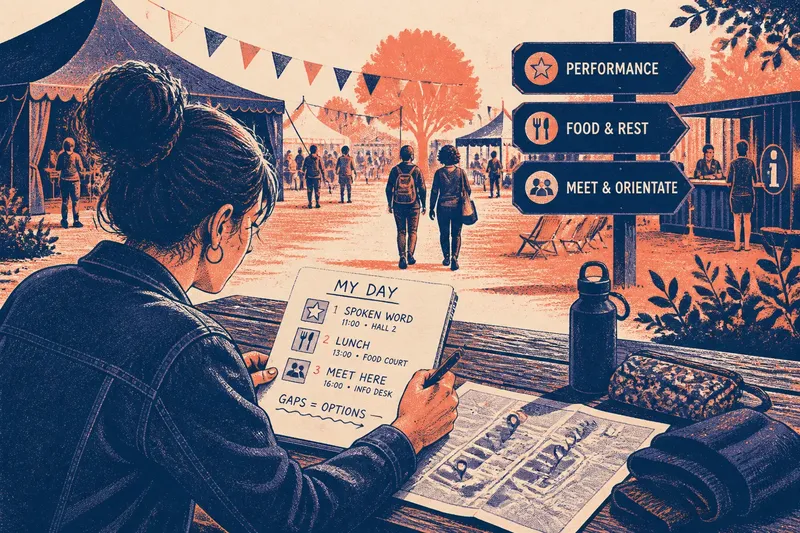
The most common mistake on a first-time festival day is trying to fill every available slot; it can turn an inviting programme into a race between stages, queues and unfamiliar paths. A simple first-time festival day plan starts with three anchors—fixed points that help you orient yourself—then leaves the spaces between them available for rest, discovery or change.
An anchor might be a performance you particularly want to see, a meal break, or a meeting point with a companion. The aim is not to predict every detail. It is to give the day a shape that still works if a queue runs long, a venue feels crowded or something unexpected catches your attention.
Start with your needs
Before opening the programme, think about what would help you feel comfortable enough to enjoy the festival. Consider how you will arrive, how much time you want to spend standing or walking, whether you need a quiet place, and what arrangements would make attending with other people easier.
Access needs are personal. You might want step-free routes, seating near a performance, captions, a quieter space, a companion ticket or a clear way to leave and return. Check the festival’s access information and contact its access team if a detail is unclear. A venue map can help you understand locations, but it may not explain every route or surface.
Make a short note of what is essential and what is a preference. That distinction can help you choose among events without treating every appealing option as equally important.
Choose three anchors
Now scan the programme for three different kinds of fixed point. A useful set often includes one event, one practical pause and one point of orientation. For example, you could choose a talk, a meal at a familiar time and a meeting place near the festival entrance. These are not rules; pick anchors that fit your own day.
- An event: choose a performance, workshop or talk you would be disappointed to miss.
- A pause: set aside time for food, a drink, medication or a sit-down, according to your needs.
- An orientation point: choose a place to meet someone, check the map or decide what to do next.
Check each event’s stated start time, location and entry arrangements. Some programmes distinguish between doors opening and a performance beginning; others may use separate spaces for access seating or late entry. When the information matters to your plans, confirm it with the organiser rather than relying on an assumption.
Say you are visiting an unfamiliar arts festival with a friend and want to see a spoken-word performance. You make that your first anchor, choose lunch as the second, and agree to meet by the information desk later in the afternoon as the third. If the walk between the performance and lunch takes longer than expected, the meeting point remains useful without requiring you to rush towards another booked event.
Map the connections
Put the three anchors in time order, then look at where each takes place. A festival map can reveal that two events are close together, separated by a busy entrance, or in different parts of a site. Consider the route as well as the distance: steps, slopes, narrow passages, temporary flooring and crowded pinch points can all affect how a journey feels.
Use the festival’s access map or venue information to check routes that matter to you. If you are unsure whether a route suits your access needs, ask the organiser for a specific description. Avoid setting a tight transition between events in different locations. A little breathing space can make the difference between arriving settled and missing the start while trying to find a way in.
Keep the plan readable. A note on your phone or a small paper card can list each anchor’s name, time, location and any relevant entry detail. Save or photograph the map if mobile reception may be limited, and identify the information point so you know where to ask for help.
Leave useful gaps
Do not assign every interval between anchors. An open gap is time you have deliberately left without a booked activity. It can absorb a queue, an unexpected route, a longer rest or a conversation with someone you meet. It can also become a chance to explore a stall or listen to music drifting from another space.
Open time is not wasted time. It gives you permission to respond to how the day is actually going rather than trying to make the day conform to a timetable made in advance. If you are attending with others, agree that either person can suggest using a gap to sit down or change direction.
For each open interval, identify a nearby option that would feel restful and one that would feel interesting. That might mean noting a seating area and a small exhibition, rather than adding both to the schedule. The choices stay available without becoming obligations.
Pack for flexibility
Pack for the conditions and access arrangements you expect, rather than for every possible problem. Useful items may include a charged phone, the festival map, any required tickets or booking confirmation, water if permitted, weather-appropriate clothing and personal items that support your access needs. Check the event’s entry rules for bags, food, mobility equipment or other items before setting out.
Keep essential information easy to reach. If you use a phone, save key details somewhere you can open quickly; if paper works better, write down the event locations and meeting point. If you are with a companion, make sure you both know what to do if you become separated, including where to seek assistance.
Comfort can depend on small choices. Shoes suited to the site, a layer you can add or remove, or a familiar snack where allowed may make it easier to use your open time as you wish. Let your own needs and the festival’s guidance determine what belongs in your bag.
Adjust as the day unfolds
At the festival, check the map and any live programme updates before moving to your next anchor. If an event changes venue or a route is closed, ask staff about the accessible alternative rather than improvising through an unfamiliar area. If a space feels uncomfortable, it is reasonable to leave and use the time differently.
Keep the anchors, but treat the gaps as genuinely flexible. You might use one to rest, follow a sound that interests you, or simply arrive early and settle. If an anchor no longer suits your energy or circumstances, decide whether another person depends on it, then revise the plan clearly with anyone you are attending with.
Leave yourself a straightforward way to finish the day. Check the return route or transport information before you need it, and avoid making your final plan depend on a last-minute dash across the site. A calm departure is part of a day that has room to change.
Questions before you go?
What if my chosen event is fully booked?
Look for the programme’s booking and entry details, including whether standby entry is offered. If you cannot attend, keep the other anchors and use the open time for an alternative that suits your energy.
How much time should I leave between events?
There is no single interval that fits every site or visitor. Check the route, entry process and your own pace, then avoid planning a transition that leaves no room for a pause or a change in conditions.
Can I plan around access needs without knowing the venue?
Start with the information the festival provides, such as access maps, seating details and contact options. Ask the access team about the specific feature you need, and keep a nearby alternative in mind if the answer changes your choices.
What should I do if I arrive late?
Find the information point or ask event staff which parts of your plan are still workable. Keep the day’s most important anchor if you can, and let the flexible time absorb whatever has changed.
A first-time festival day plan works best when its fixed points support your choices rather than crowd them out. Before leaving, make sure you can find your three anchors and the information you need; then let the spaces between them remain open enough for the festival to surprise you.