Open Field or Courtyard? Choosing a Festival Gathering Space
Choosing an open field or courtyard for a festival? Match the setting to the interaction you want, from loose mingling to a more focused shared gathering.
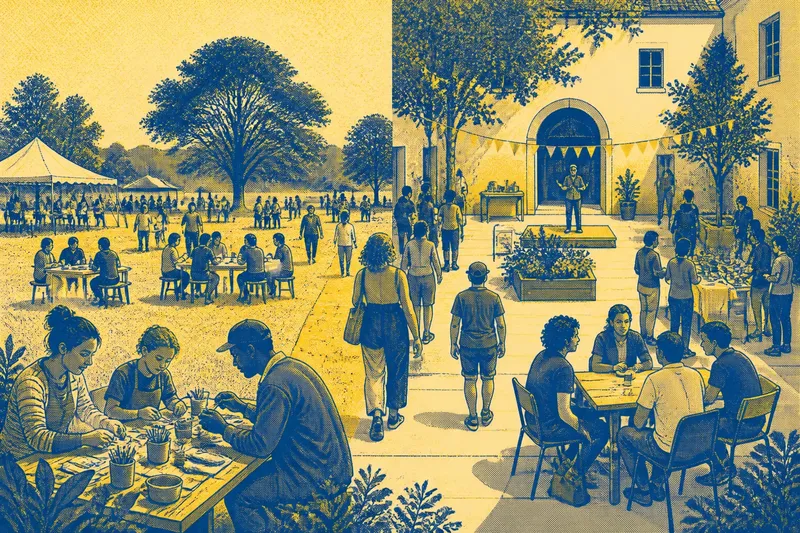
The common mistake when choosing an open field or courtyard for a festival is to pick the more attractive-looking site before deciding how people should meet. That can cost a gathering its purpose: a field may scatter a conversation, while a courtyard may make a relaxed drop-in feel like an audience waiting for a show. Begin with the kind of interaction you want, then judge the space by how readily it supports it.
What gathering do you want?
Write down what visitors should be able to do together, in ordinary terms. Are they meant to drift between small conversations, watch one shared activity, take part in a communal meal, or move between all three? The answer is more useful than a visual preference because it describes behaviour the layout must accommodate.
An open field usually offers room for several groups to form and shift independently. That can suit informal mingling, participatory activities and a programme where no single focal point should dominate. It can also make a shared moment feel dispersed if people do not naturally orient towards the same place.
A courtyard, or another space with a clearly bounded edge, tends to give a gathering a stronger sense of being held together. Its walls, planting, buildings or other boundaries help people recognise the shared area. That can support a communal welcome, performance or meal, although a strong centre may make side conversations and circulation feel secondary.
Say you are planning a neighbourhood gathering where visitors should make things together at several tables. In an invented scenario, placing worktables in separate clusters across a field would give each activity breathing room, but newcomers might not know where to begin. A courtyard with tables around a visible central welcome point could make the invitation easier to read; the observable result to look for would be visitors joining different tables without treating one as the only event.
Put the intended social behaviour into one sentence before comparing sites.
How does enclosure change interaction?
Enclosure is not simply the presence of walls. It is the degree to which the edges of a place make its centre feel distinct from its surroundings. A courtyard can feel enclosed because buildings frame it, while a field can gain a similar sense of definition from trees, temporary structures or the arrangement of activity. Conversely, a courtyard with a broad opening may feel open and permeable.
In a more enclosed-feeling layout, people can often see that they have arrived in a common space. This helps a group share attention: a speaker, a food table or a communal activity can become legible from several points. The same quality can make a quiet visitor feel conspicuous, especially if there are few places to pause without joining the main activity.
An open layout gives visitors more choice about how close to come and where to linger. It can make parallel conversations feel natural, and it gives organisers room to separate activities without placing them behind a hard boundary. But openness can dilute the sense of occasion. If every direction offers an equally plausible destination, people may circulate without understanding where the gathering is centred.
Consider the edges as part of the invitation. A bench beside the main activity offers a different kind of participation from a ring of chairs facing it. A low platform, a row of stalls or a clear patch of ground can shape attention without closing the space. The question is not whether the plan looks open or enclosed on paper; it is what a visitor can infer from its boundaries.
Will visitors know where to go?
A festival space should make its basic choices understandable at a glance: where to enter, where the main gathering is, where activities happen and where someone can step aside. This is the site’s legibility. A compact courtyard may make the centre obvious but hide entrances or secondary activities. A field may offer many approaches while leaving the centre ambiguous.
Walk the site from the perspective of someone arriving for the first time. Notice what is visible before entry, what appears immediately after it and whether people can see the next useful place from where they are standing. Sightlines matter because signs cannot do all the work: a sign may name a gathering point, but a visible gathering gives that direction meaning.
Look particularly at the relationship between the entrance and the activity. If the entrance opens directly onto a dense cluster, newcomers may hesitate before crossing it. If the entrance is far from the main activity, visitors may not realise that they have reached the event. A welcoming threshold—a visible host, a clear open route or an activity that can be watched before joining—can ease that first decision.
Use a simple site sketch to mark entrances, the main shared activity, quieter places and any point where visitors must choose a direction. Then check whether each choice is visible or needs a sign, a person or a distinct landmark.
How will people move and pause?
People need to move through a festival and to stop within it. Those actions compete when a popular activity sits across the most direct route, or when a food queue occupies the only comfortable place to watch. A field makes it easier to spread activities apart, but distance between them can make the route feel like a trek. A courtyard keeps destinations close, yet its edges can become crowded when many visitors follow the same loop.
On a plan, draw the likely paths between the entrance, gathering point, activity areas, refreshments and facilities. Mark where visitors might stop to talk or watch. Then look for crossings: a route through the middle of a seated audience, for example, interrupts both movement and attention. The aim is not to dictate every step, but to let people pass without repeatedly cutting through someone else’s moment.
Pause points need deliberate space too. A visitor may want to read a display, wait for a companion, watch briefly or take a break without blocking a route. In an open field, a small cluster of seats or a shaded edge can provide that option. In a courtyard, a bench or standing area outside the main line of movement can serve the same role.
Think of the layout as a set of invitations rather than a map of destinations: an obvious route onward, a place to linger and a way to join an activity without forcing others to move.
What about sound and comfort?
Sound changes the character of a gathering. In an enclosed courtyard, hard walls and paving may reflect voices and music, making the space feel lively but also harder to listen in. An open field may let sound disperse, so a spoken introduction can lose presence unless the audience is close. Neither setting is automatically better; the relevant question is whether sound should gather people’s attention or remain part of the background.
Walk the site at the time of day the festival is expected to use it, if access allows. Listen from the places where visitors would stand or sit, not just from the proposed performance point. Notice nearby traffic, other activities, reflective surfaces and places where a quieter conversation might be possible. A layout with distinct activity zones can help different sound levels coexist, provided the zones do not interrupt one another’s purpose.
Comfort is also shaped by what the space offers at its edges. Trees, awnings and building shade can make a place easier to use for lingering; exposed ground can leave people searching for cover. A courtyard may shelter visitors from some conditions but hold warmth or create a draught through a narrow opening. A field may feel spacious but provide little relief from sun, wind or rain. Check the actual site and the event’s likely conditions rather than relying on the name of the setting.
Which format suits mixed activities?
If the event combines a central shared moment with separate things to browse, a hybrid arrangement can take advantage of both types of space. A field can use a clear central gathering point with activity clusters around its edges. A courtyard can preserve an open middle while placing quieter or self-guided activities along its boundary. In either case, visitors should be able to understand which parts invite gathering and which offer a choice to wander.
Keep the main activity visible without making it the only legitimate way to participate. A person should be able to watch from the edge, join briefly, or move to another activity without appearing to leave the event altogether. That flexibility matters particularly for social gatherings where visitors arrive at different times or come with different levels of familiarity.
Do not let a hybrid plan become a collection of competing centres. If several activities each claim the same visual prominence, visitors may find it hard to tell what is shared and what is optional. Give each zone a clear character through its position, furnishings or simple signs, and leave enough separation for one activity not to overwhelm another.
How can you compare sites?
Use a short visit and a marked-up sketch to compare actual places. A site can look spacious in photographs yet feel confusing from its entrance; another may appear modest but have a clear threshold and useful edges. Check each candidate against the intended interaction rather than giving points for atmosphere alone.
- Arrival: Can a first-time visitor recognise the entrance and see a reason to come in?
- Shared focus: Is there a place where people can gather without blocking the main route?
- Choice: Can visitors join, watch or step aside without being funnelled into one activity?
- Movement: Can people reach the main destinations without crossing through queues or seated groups?
- Pause: Are there suitable places to wait, talk quietly or rest near the activity?
- Conditions: What do shade, shelter, sound and nearby uses mean for the expected gathering?
- Access and operation: Can the planned audience and event needs be accommodated at the site? Confirm relevant arrangements with the venue and follow applicable local requirements.
Compare the notes by asking which place makes the desired behaviour easiest to understand and carry out. A drawback may be manageable through a different arrangement; a mismatch between the site’s character and the gathering’s purpose is harder to solve with decoration.
Which site should you choose?
Is a field better for informal mingling?
A field often suits mingling when visitors should form small groups, move between activities and choose their own level of involvement. It works best when a visible centre or recognisable landmarks prevent the space from feeling directionless.
Does a courtyard suit a shared meal?
A courtyard can help a meal feel communal because its edges make the gathering easier to read. Check that seating, serving and movement do not all compete for the same narrow route, and provide a way to pause outside the busiest area.
Can a field feel intimate?
Yes, if its layout gives people a clear place to gather and nearby edges that make smaller groups comfortable. A ring of seats, a sheltered activity area or a well-defined cluster can create closeness without enclosing the whole site.
Can a courtyard feel relaxed?
Yes, if visitors have several ways to take part and are not all directed towards one focal point. Place some activities around the edge and keep a route through the space clear, so the courtyard reads as a place to linger rather than a room with an implied audience.
What is the final decision?
Choose the site that supports the social pattern you want with the least explanation. If visitors should drift, talk and discover, favour a layout that offers room and visible choices. If they should share attention and feel gathered, favour a layout whose boundaries make the common space clear. Where neither site does the job by itself, adjust the arrangement before adding more signs or decoration.
When comparing an open field or courtyard, return to the intended interaction and imagine a visitor arriving, joining, pausing and leaving. The strongest choice is the one that makes those actions feel natural while leaving room for people to participate in their own way.