The Festival Run Sheet: Why Sequence Matters as Much as Timing
A festival run sheet works better when it plans handoffs as well as start times, helping audiences, performers and crews move through the day with clarity.
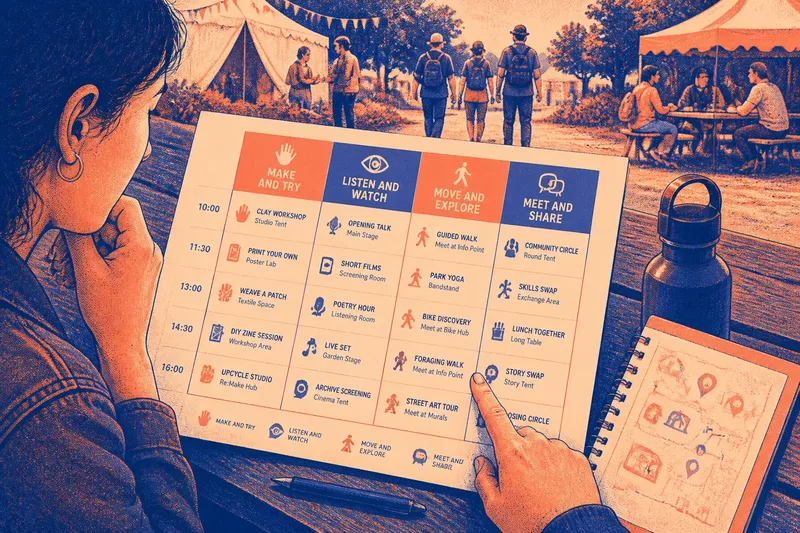
The most common mistake in a festival run sheet is treating it as a list of start times. That can leave a band finishing to an empty stage, a discussion ending just as the next audience arrives, or a crew scrambling to clear equipment while people wait. A run sheet is a sequence of events and transitions; plan the handoffs, and the day becomes easier to follow and deliver.
Sequence gives the day shape
Timing tells a team when an item begins and ends. Sequence explains why it comes next, what it asks of the audience, and what must happen before the following item can start. A timetable can be accurate yet still feel disjointed if every event is planned in isolation.
Think of each programme item as having a beginning, a main activity and an ending. A short welcome might orient people before a participatory workshop. The workshop may then lead naturally into a performance that draws on what people have just made. The order creates a thread, even when each item has a different presenter or format.
This is not a demand for a single story that every attendee must follow. People arrive late, leave early and choose different activities. The aim is to make the transitions legible: a visitor should be able to tell what is happening now, what is coming next and how to move between them.
Map the handoffs
A handoff is the change from one item or operating state to another. It can involve a performer leaving a stage, a facilitator resetting tables, a queue forming, or an audience shifting its attention from a speaker to a demonstration. These changes need time, people and clear responsibility.
For each adjacent pair of items, ask what the first leaves behind and what the next needs. A poetry reading may require a quiet exit and a clear stage; the following dance workshop may need an open floor and a facilitator ready to welcome newcomers. If the transition is not planned, the schedule may promise two incompatible uses of the same space.
Record the handoff alongside the public-facing item. A useful internal entry might name the outgoing lead, the incoming lead, the change required and the signal that the next item can begin. This makes responsibility visible without filling the audience programme with production detail.
- What must be cleared, moved or made ready?
- Who owns each part of the change?
- Where will the audience wait or go during it?
- What tells the next lead that the space is ready?
Keep the handoff specific enough that someone can act on it without guessing.
Build a readable rhythm
Rhythm is the pattern of attention and effort across a festival day. A sequence of loud, high-energy items may feel relentless; a long run of talks may leave little change in how people participate. Alternating formats can help, but variety alone is not the point. Consider how each item asks people to listen, move, make, watch or rest, then place changes where they help the day breathe.
Duration and intensity are different. A lengthy seated performance may demand sustained attention, while a shorter participatory activity may ask for more physical or social effort. When two demanding items sit back to back, the transition should offer a genuine change of pace rather than another queue or instruction-heavy pause.
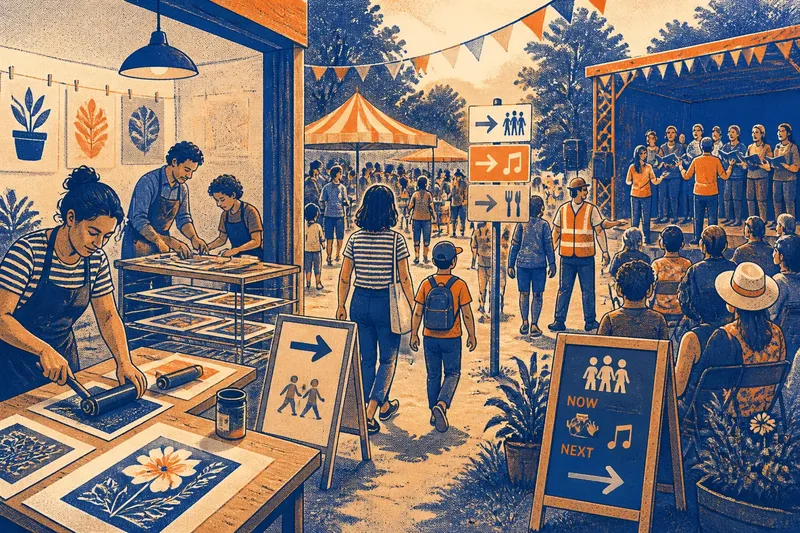
Imagine a neighbourhood festival with a hands-on printmaking session followed by a local choir. If the choir begins immediately in the same crowded room, participants may still be handling ink and looking for somewhere to put their work. If the run sheet places a clear close to the workshop, allows the team to protect drying prints, and gives people a simple route to the next space, the choir can start with an audience that understands the change.
The useful question is not merely whether each item fits. Ask what state people will be in when it ends, and what state the next item needs from them.
Account for overlap
Festival transitions rarely happen in a sealed room. Sound carries, queues cross paths, and one audience may arrive while another is leaving. A schedule that works on paper can become confusing if two nearby items compete for attention or draw people through the same narrow route at once.
Look at transitions from the point of view of someone moving through the site. If a family activity ends near the entrance to a performance area, tell stewards which flow takes priority and where arrivals should gather. If a quiet discussion overlaps with a sound check, consider whether the discussion needs a different setting or a revised sequence.
Overlap can also be deliberate. A food demonstration might continue while a nearby craft stall opens, giving people a gradual way to shift activities. But an overlap only feels intentional if each item has a clear start, a clear finish and enough space for people to choose whether to stay or move on.
Write useful transitions
On the public programme, describe the change in plain language. “Workshop close and room reset” belongs on the crew run sheet; “Next, join the choir in the courtyard” helps visitors understand where to go. Avoid leaving a gap that looks like an unexplained cancellation, especially if the interval is needed to move equipment or prepare a space.
For spoken transitions, decide who gives the cue and what they need to say. A host might thank the departing participants, name the next activity, and point towards its location. Keep this short and concrete. If people need to carry materials, register, or enter through a particular door, say so before they start moving.
Where the right answer depends on venue conditions, equipment labels, manufacturer instructions or local rules, follow those directions and seek a qualified professional for safety-critical production decisions.
Questions about sequencing?
How much time should a festival transition have?
Allow enough time for the actual change: audience movement, equipment handling, room reset and any necessary sound check. The right allowance depends on the space and the items involved, so verify it with the people responsible for delivering the handoff.
Should every gap appear on the public programme?
Show a gap when visitors need to understand that an interval is intentional or need guidance about where to go. Keep internal tasks, such as a stage reset, on the crew run sheet unless they affect the audience’s choices.
What if an event runs late?
Decide in advance who can adjust the sequence and which items can be shortened, moved or held. Give presenters and front-of-house staff a shared way to communicate changes, then tell affected audiences plainly rather than letting uncertainty spread.
Can two activities run at once?
Yes, if the overlap suits the sound, movement and staffing needs of both activities. Check that attendees can locate each one, choose between them, and leave without blocking the other audience.
Keep one working version
A run sheet is useful only when the people delivering the day share the same current version. Give it a clear owner, identify which details are public and which are operational, and mark changes so that stage managers, hosts and stewards are not relying on different timings or room plans.
Before doors open, walk through the sequence with the leads who own the transitions. They can confirm where people wait, which items need a reset, and who gives each cue. If a handoff remains unclear in conversation, it is unlikely to become clearer during a busy programme.
A well-sequenced festival run sheet does more than place activities in order. It makes the passage between them visible, so crews can prepare and visitors can move through the day with confidence. Treat every handoff as part of the programme, not an empty space between its entries.