From Seasonal Fair to Annual Festival: How Recurrence Builds Tradition
Learn how an annual festival builds tradition through familiar dates, shared rituals and thoughtful change, while keeping its identity open to new participants.
The common mistake in turning a seasonal fair into an annual festival is to change too much at once: a new date, venue, name and ritual can leave returning visitors unsure what they are meant to recognise. An annual festival builds tradition through repetition, but that repetition is useful only when people can tell what is being carried forward and why.
Tradition need not mean an ancient custom or a fixed programme. It can begin with a modest, recognisable action that people expect to share each year. Organisers then face a choice: preserve one clear ritual, let a wider set of customs grow organically, or combine a stable core with room for local variation. Each approach suits a different community and level of organisation.
Begin with a reliable return
A seasonal fair often happens when a harvest, school break, religious observance or local season brings people together. Repeating the event around the same point in the year gives it a dependable place in community memory. The exact date may shift to suit a weekend or local calendar; what matters is that the reason for returning remains legible.
Choose a cue that can be communicated plainly: the first Saturday after the village’s spring planting day, the weekend when the market square fills with autumn produce, or the evening when neighbours gather to mark the longest days. A stable seasonal cue is often more meaningful than insisting on an identical calendar date, particularly when the date would conflict with local observances or practical constraints.
Consistency also helps people tell others what the festival is. “The lantern walk that welcomes the autumn market” carries more identity than a general invitation to attend an event. The cue need not dictate the entire programme; it simply gives the gathering a recognisable return point.
Keep the reason for the date visible in invitations and on-site signs.
Three tradition models
There is no single route from fair to festival. These approaches differ in how much organisers define, how much participants contribute and how easily the event can adapt.
The fixed annual ritual
Here, one shared action anchors the gathering: opening a community banner, singing a local song, exchanging seed packets or lighting a ceremonial lantern. Organisers make the ritual easy to understand and repeat, while the surrounding stalls, performances and food can change.
This suits a small organising team or a community that values a clear centrepiece. It also gives newcomers an obvious way to join, provided the action is explained without assuming family history or specialist knowledge. A ritual can feel exclusive if participation depends on knowing an unwritten rule, owning particular clothing or belonging to a particular group.
The community-led custom
In this model, residents and groups contribute practices that gradually become associated with the festival. A school might display student-made decorations, a growers’ group might bring seasonal produce, and a local choir might offer a short performance. Organisers provide a common setting rather than deciding every custom in advance.
This approach suits a festival with many active neighbourhood groups and organisers who can coordinate invitations and practical arrangements. It can reflect a changing community, but it needs a light touch of stewardship: new contributions should not crowd out existing ones, and participation should not depend on a single person who may be unavailable next year.
The stable core with rotating features
A hybrid keeps one or two familiar elements while inviting a fresh theme, guest group or creative contribution each year. The core tells people what event they have returned to; the changing layer makes space for new interests and circumstances.
This often suits a growing festival that wants recognition without asking every edition to look alike. It does require organisers to distinguish between the part that carries identity and the part that can vary. If both shift at once, the festival may feel like a different event rather than a developing tradition.
What should stay familiar?
Familiarity does not have to come from a large ceremony. It may be a printed programme with a recurring illustration, a shared welcome led by rotating community groups, a craft made from locally available materials, or a public display that gathers contributions from the year.
Choose something people can take part in without substantial cost, specialist skill or a private invitation. A custom is more likely to belong to the community when spectators can understand it, participants can join at different levels, and organisers can explain its meaning in ordinary language.
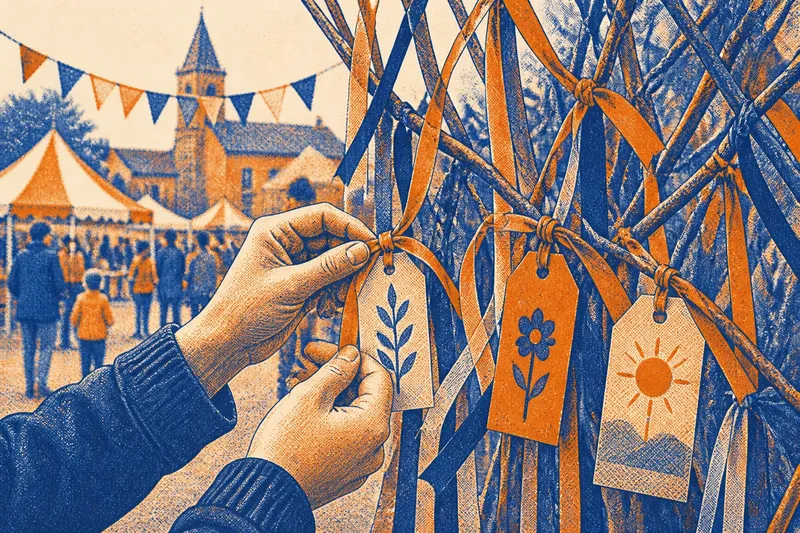
Imagine a small town fair that has no established closing custom. Its organisers invite visitors to add a ribbon bearing a wish for the coming season to a public display; the display is taken down after the fair, and a different local group introduces it the following year. The expected visible result is a shared feature that visitors can recognise and help shape, without requiring the same wish or group to return.
Write down the ritual’s purpose, who can take part and what needs arranging. That short record makes it easier to hand the custom on when volunteers change.
Which approach fits your festival?
Use the character of the community, rather than a wish for instant recognition, to choose a model. A fixed ritual can offer clarity; community-led customs can show many voices; a stable core with rotating features can balance recognition and renewal.
- Choose a fixed ritual if the festival needs one simple, repeatable point of connection and someone can explain it to first-time visitors.
- Choose community-led customs if local groups already contribute and organisers have a fair way to invite, coordinate and share space among them.
- Choose a stable core with rotating features if people recognise the event but want its creative contributions to reflect changing interests.
- Pause before formalising a custom if it depends on one person, excludes some residents or has a meaning that organisers cannot explain clearly.
Whatever the model, make participation voluntary. A tradition should invite people into a shared moment, not make them prove that they belong.
How should traditions change?
How many rituals should a festival keep?
Keep only the customs people can recognise and organisers can sustain. One well-understood ritual can give an event a stronger identity than a crowded collection whose purpose is unclear.
Can a new festival have a tradition?
Yes. A custom becomes recognisable through repetition and shared meaning, not through a claim of great age. Describe it honestly as a new or developing festival custom.
What if the original ritual no longer fits?
Ask participants what meaning the ritual carries and which parts still serve them. The festival can retain that meaning through a different action, while explaining the change rather than presenting the new form as if nothing has shifted.
How can newcomers join without knowing the rules?
Explain the custom in the programme and at the place where it happens, using direct language about what people may do. Offer a way to watch or take part lightly, so joining does not require prior knowledge.
Keep the memory usable
After each edition, record what the custom involved, who helped shape it and what organisers would adjust. This is not a formal history project; a note in a shared planning document, a dated photograph with permission, or a short account from participating groups may be enough to help the next team make an informed choice.
Ask participants whether the ritual felt welcoming and whether its meaning was clear. Treat comments as guidance, not a vote that must preserve every detail. A tradition can remain recognisable while changing its materials, its contributors or the words used to introduce it.
When a recurring festival has a familiar return cue, a custom people can enter and a clear way to adapt it, the seasonal fair begins to acquire shared identity. The most durable annual festival tradition is not necessarily the one that never changes; it is the one the community can recognise, explain and choose to carry forward.